
7. Praise Opens the Way
Hover over or Tap the red scripture references to view content.
Enter His Gates with Thanksgiving: The Journey of Praise into God’s Presence
“Enter into His gates with thanksgiving, and into His courts with praise. Be thankful to Him, and bless His name.”
Psalm 100:4
Psalm 100:4 is one of the most beautiful invitations in Scripture. It does not begin with fear, distance, or religious performance. It begins with an invitation to enter. God calls His people to come near, and the way He teaches us to come is with thanksgiving, praise, gratitude, and blessing.
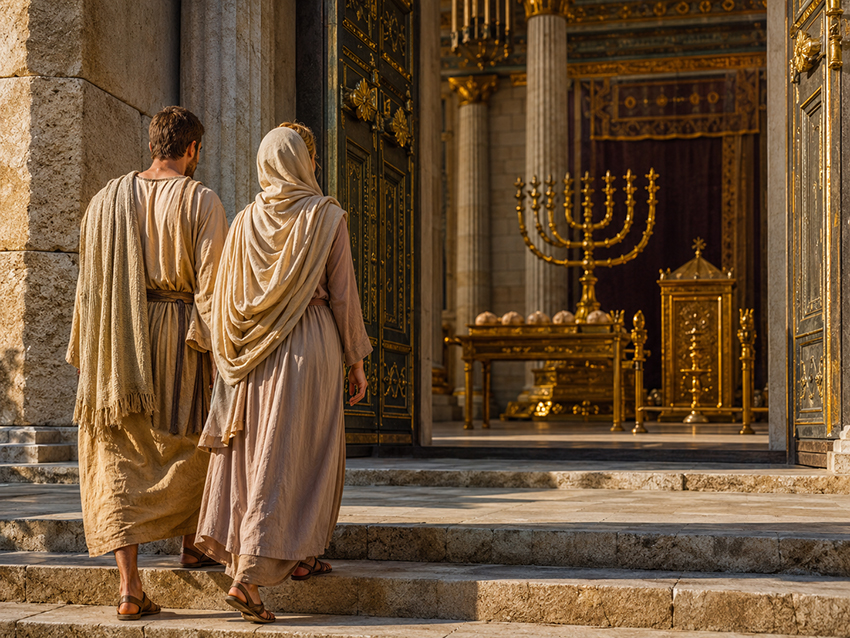
This verse was written in a world where worship was deeply connected to the temple. The people of Israel understood that approaching God was not careless or casual. There was a holy order to worship. There were gates, courts, sacrifices, priests, a Holy Place, and beyond the veil, the Holy of Holies. Psalm 100:4 uses this temple language to teach us something powerful: praise is not only something we do after we feel close to God; praise is often the way we begin drawing near to Him.
1. “Enter His Gates with Thanksgiving”
The first movement is through the gates. Gates speak of access. In the Old Testament, the worshipper did not remain outside forever. God made a way for His people to come toward Him. But the entrance was not meant to be filled with complaining, bitterness, fear, or self-pity. The Psalm says we enter with thanksgiving.
Thanksgiving means we deliberately remember what God has done. We remind our own hearts that He has been faithful. Before we ask for more, we acknowledge what He has already given. Before we focus on what is missing, we remember what is present. Thanksgiving shifts our attention from the size of our problems to the goodness of our God.
Many times, the hardest part of prayer is simply entering. Our minds are busy. Our emotions are heavy. Our circumstances feel loud. But thanksgiving opens the gate. It helps our hearts turn away from anxiety and toward God’s faithfulness.
2. “And into His Courts with Praise”
After the gates came the courts. The courts were places of worship, sacrifice, gathering, and service. In the temple, the people of Israel would come into the outer courts to bring offerings and worship before the Lord. Praise was not hidden away as a private emotion only; it was expressed before God.
Praise is different from thanksgiving. Thanksgiving thanks God for what He has done. Praise honours God for who He is. We thank Him because He has provided, protected, forgiven, restored, and answered. But we praise Him because He is holy, faithful, merciful, righteous, powerful, and good.
This is important because praise does not depend entirely on our circumstances. Even when we do not yet see the answer, God is still worthy. Even when we are walking through a difficult season, His nature has not changed. Praise declares the truth about God above the noise of our situation.
3. The Old Testament Temple Journey
To understand the depth of Psalm 100:4, it helps to picture the temple journey. The temple was built according to a holy pattern. It revealed both the nearness of God and the holiness of God. God wanted to dwell among His people, but He also taught them that sin could not be treated lightly.
The first area was the outer court. This was where the altar of sacrifice stood. In Solomon’s temple there was also the great bronze sea, used in connection with priestly washing and cleansing. The outer court reminds us that sinful people cannot approach a holy God without sacrifice and cleansing. Worship began with the recognition that atonement was necessary.
From there, the priests would minister in the Holy Place. Inside the Holy Place were sacred items that pointed to fellowship and worship before God. The golden lampstand gave light, reminding us of God’s revelation and presence. The table of showbread represented fellowship, provision, and covenant relationship. The altar of incense stood before the veil, and the incense rising upward symbolised prayer and worship ascending before the Lord.
Beyond the Holy Place was the veil. Behind the veil was the Holy of Holies, the most sacred place in the temple. There stood the ark of the covenant, and above it was the mercy seat. This was the place associated with the manifest presence of God. But under the Old Covenant, not everyone could enter there. Only the high priest could enter the Holy of Holies, and only once a year, on the Day of Atonement, with blood.
“But into the second part the high priest went alone once a year, not without blood, which he offered for himself and for the people’s sins committed in ignorance.”
Hebrews 9:7
This journey from the outer court to the Holy of Holies teaches us that worship is a movement toward God. It begins with entrance, continues with praise, involves cleansing and sacrifice, rises in prayer, and longs for the presence of God Himself.
4. Praise Is a Journey Toward His Presence
Psalm 100:4 does not mention the Holy of Holies directly, but it gives us the beginning of the journey: gates and courts. Thanksgiving brings us through the gates. Praise brings us into the courts. From there, the whole temple pattern points us toward a deeper truth: God desires His people to come near.
In the Old Testament, access was limited. The people could come to the courts, the priests could minister in the Holy Place, and the high priest alone could enter the Holy of Holies once a year. But all of this was pointing forward to Jesus Christ.
When Jesus died on the cross, the veil of the temple was torn from top to bottom. This was not a small religious symbol. It was a powerful declaration from heaven that through the blood of Jesus, the way into God’s presence had been opened.
“Then, behold, the veil of the temple was torn in two from top to bottom.”
Matthew 27:51
Because of Christ, we do not merely stand at a distance. We do not worship as outsiders. We come through the finished work of Jesus. He is our sacrifice, our High Priest, our cleansing, our access, and our righteousness before God.
“Therefore, brethren, having boldness to enter the Holiest by the blood of Jesus…”
Hebrews 10:19
5. Thanksgiving Prepares the Heart
Thanksgiving is powerful because it humbles the heart. A thankful person recognises that everything good comes from God. Pride says, “I deserve this.” Entitlement says, “I should have more.” But thanksgiving says, “Lord, You have been good to me.”
When we begin prayer with thanksgiving, we are not pretending that life is easy. We are choosing to remember that God is faithful. We are training our hearts to see His hand. Thanksgiving helps remove spiritual heaviness and brings our hearts into alignment with truth.
This is why praise and thanksgiving are not small parts of worship. They are often the doorway into a deeper awareness of God’s presence.
6. Praise Blesses His Name
The verse ends by saying, “Be thankful to Him, and bless His name.” In Scripture, the name of the Lord represents His character, nature, authority, and reputation. To bless His name means to speak well of God, to honour Him, and to declare who He truly is.
We bless His name when we say, “Lord, You are faithful.” We bless His name when we declare, “You are holy, merciful, gracious, mighty, and good.” We bless His name when we worship Him not only for what He gives, but for who He is.
This kind of praise changes the atmosphere of the heart. It lifts our eyes from ourselves to God. It reminds us that we are not approaching a distant religious system, but a living Father who has made a way for us through Jesus Christ.
7. How We Apply Psalm 100:4 Today
Today, we do not travel to the physical temple in Jerusalem to meet with God. Through Christ, believers have access to the Father by the Holy Spirit. Yet the principle of Psalm 100:4 remains deeply practical.
When you pray, begin with thanksgiving. Thank God for His mercy, His provision, His protection, His forgiveness, His Word, His Spirit, and His faithfulness. Then move into praise. Declare who He is. Worship Him above your circumstances. Bless His name before you bring your requests.
This does not mean we ignore pain or pretend everything is perfect. It means we come to God in the right posture. We enter with gratitude, we draw near with praise, and we trust that through Jesus Christ, we are welcomed into the presence of God.
Conclusion: Praise Opens the Way
Psalm 100:4 teaches us that praise is not just a song; it is a spiritual approach. Thanksgiving brings us through the gates. Praise brings us into His courts. The temple journey reminds us that God is holy, but the cross reminds us that the way has been opened.
Under the Old Covenant, the Holy of Holies was hidden behind the veil. Under the New Covenant, Jesus has torn the veil and brought us near. Therefore, we do not worship from the outside. We come with confidence, humility, thanksgiving, and praise.
So when your heart feels far from God, begin at the gate. Start with thanksgiving. Step into the courts with praise. Bless His name. And remember that through Jesus Christ, you are invited to draw near to the presence of the living God.