
The Name of God: YHWH, the Tetragrammaton, and the God We Worship
Hover over or Tap the red scripture references to view content.
Who Do We Serve, and Who Do We Worship?
One of the most important questions any believer can ask is this: Who is the One we worship?
In many churches today, worship songs are often filled with words such as, “I love You, You love me,” but sometimes very little is said about who the “You” is. The words may be emotional, sincere, and beautiful, but the identity of the One being worshipped can become unclear.
The words God and Lord are true and honourable titles, but they are still titles. They can be used in many religions and even for false gods. The God of the Bible did not only reveal Himself by titles. He revealed Himself personally — by His Name.
When Jesus taught us to pray, He did not begin with our needs. He began with the Father’s Name:
“In this manner, therefore, pray:
Our Father in heaven,
Hallowed be Your name.”Matthew 6:9, NKJV
To “hallow” His Name means to treat it as holy, sacred, weighty, and set apart. We are not dealing with a vague religious idea. We are worshipping the living God, the Creator of heaven and earth, the God of Abraham, Isaac, and Jacob, the Father of our Lord Jesus Christ.
This study is not about using God’s Name as a formula, a charm, or a way to manipulate Him. The Almighty is sovereign. No man can control Him by knowing, speaking, or writing His Name. Rather, this study is about returning to biblical clarity: the One we worship has revealed Himself, and His Name reveals His character, authority, holiness, and covenant faithfulness.
Why Is a Name Important in Scripture?
In modern English, a name is often treated as a label. It identifies a person, but it may say very little about that person’s character. In the Bible, however, a name is often much more than a label.
The Hebrew word for name is shem. It can refer to a person’s reputation, authority, character, memorial, and revealed identity. To know God’s Name is not merely to know how to pronounce a word. It is to know who He is.
This is why Scripture speaks so often about trusting in His Name, calling upon His Name, fearing His Name, blessing His Name, and not profaning His Name.
“The name of the LORD is a strong tower;
The righteous run to it and are safe.”Proverbs 18:10, NKJV
“And it shall come to pass
That whoever calls on the name of the LORD
Shall be saved.”Joel 2:32, NKJV
“Give unto the LORD the glory due to His name;
Worship the LORD in the beauty of holiness.”Psalm 29:2, NKJV
The Name is holy because the Person is holy. The Name is powerful because the Person is powerful. The Name is faithful because the Person is faithful.
What Is the Tetragrammaton?
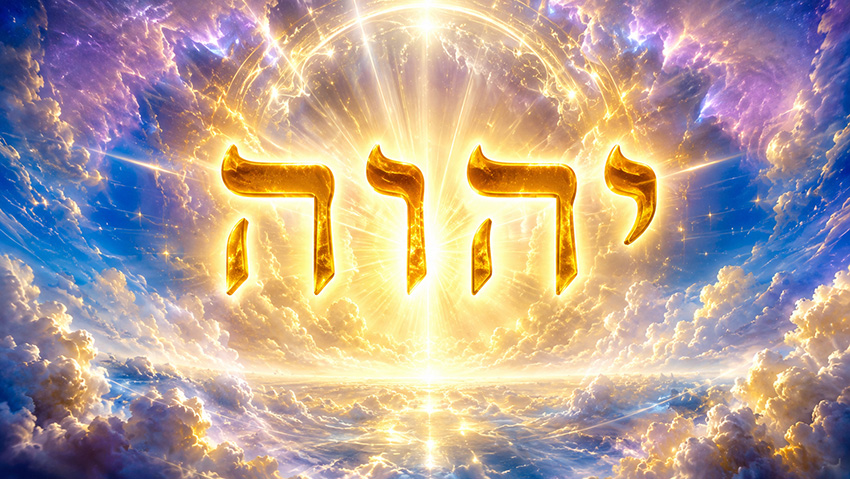
The word Tetragrammaton comes from Greek and means “four letters.” It refers to the four Hebrew letters of God’s covenant Name:
 יהוה
יהוה
Hebrew is read from right to left. These four letters are commonly transliterated into English as:
YHWH
The letters are:
Yod – He – Waw/Vav – He
In many English Bibles, including the NKJV, this Name is usually represented by LORD in capital letters. When you see LORD in the Old Testament, it usually indicates that the Hebrew text contains YHWH.
God Revealed His Name to Moses
The great revelation of the Name comes in Exodus 3, when God appears to Moses in the burning bush.
“And God said to Moses, ‘I AM WHO I AM.’ And He said, ‘Thus you shall say to the children of Israel, “I AM has sent me to you.”’
Moreover God said to Moses, ‘Thus you shall say to the children of Israel: “The LORD God of your fathers, the God of Abraham, the God of Isaac, and the God of Jacob, has sent me to you. This is My name forever, and this is My memorial to all generations.”’”
Exodus 3:14–15, NKJV
This is one of the most important passages in the entire Bible.
God does not reveal Himself as an impersonal force. He is not merely “a higher power.” He is not one god among many. He is the self-existent One. He is the One who is. He is not created, dependent, limited, or changeable.
The connection between “I AM” and YHWH shows that God’s Name is tied to His eternal existence, His covenant faithfulness, and His sovereign power.
He is the God who was, who is, and who is to come.
“This Is My Name Forever”
God did not present His Name as temporary.
“This is My name forever, and this is My memorial to all generations.”
Exodus 3:15, NKJV
The word “memorial” is important. God’s Name is not only a sound to be spoken; it is a remembrance of who He is. His Name carries His covenant identity.
This explains why Scripture repeatedly says:
“I am the LORD, that is My name;
And My glory I will not give to another,
Nor My praise to carved images.”Isaiah 42:8, NKJV
“As for our Redeemer, the LORD of hosts is His name,
The Holy One of Israel.”Isaiah 47:4, NKJV
“Therefore behold, I will this once cause them to know,
I will cause them to know
My hand and My might;
And they shall know that My name is the LORD.”Jeremiah 16:21, NKJV
The God of the Bible is not ashamed of His Name. He declares it, attaches His glory to it, and promises that the nations will know it.
How Often Does YHWH Appear in the Old Testament?
The Tetragrammaton appears thousands of times in the Hebrew Old Testament — commonly counted at around 6,800 occurrences, depending on textual counting methods. It is by far the most frequent personal Name of God in the Hebrew Scriptures.
This matters.
God could have chosen to reveal Himself only through titles such as El, Elohim, Adonai, or El Shaddai. These titles are meaningful and biblical, but His covenant Name is YHWH.
Elohim is a title meaning God, god, mighty one, or mighty ones depending on context. It is not, strictly speaking, God’s personal covenant Name. In Scripture, even human rulers or representatives can be described with related language in certain contexts.
“So he shall be your spokesman to the people. And he himself shall be as a mouth for you, and you shall be to him as God.”
Exodus 4:16, NKJV
“So the LORD said to Moses: ‘See, I have made you as God to Pharaoh, and Aaron your brother shall be your prophet.’”
Exodus 7:1, NKJV
This does not mean Moses became the Almighty. It shows that words such as El and Elohim can function as titles of authority, power, or representation. But YHWH is the revealed covenant Name of the God of Israel.
The Name Must Not Be Used in Vain
“You shall not take the name of the LORD your God in vain, for the LORD will not hold him guiltless who takes His name in vain.”
Exodus 20:7, NKJV
This commandment is often understood only as a warning against using God’s Name as a swear word. That is certainly included, but the commandment goes deeper.
To take His Name “in vain” means to carry, use, lift up, or represent His Name falsely, emptily, or worthlessly. It is not merely about pronunciation. It is about reverence, truth, and covenant faithfulness.
We take His Name in vain when we claim to belong to Him but live as though He is not holy. We take His Name in vain when we use religion for selfish gain. We take His Name in vain when we speak for Him falsely.
The solution is not to hide His Name, but to honour it.
Why Do Most Bibles Say “LORD” Instead of YHWH?
By the time of later Jewish tradition, the Name was considered so holy that many avoided pronouncing it aloud. When readers came to YHWH in the Hebrew text, they would often say Adonai, meaning “Lord” or “My Lord,” instead.
It is sometimes claimed that Adonai came from the pagan name “Adonis.” However, Adonai is a Hebrew word meaning “Lord” or “Master,” from the root adon. While “Adonis” is related to a broader Semitic root meaning “lord,” the biblical word Adonai itself was not borrowed from the worship of Adonis.
After the Babylonian Exile, and especially from about the third century BC onward, Jewish readers increasingly avoided pronouncing the divine Name and substituted Adonai in synagogue reading. In the Greek Septuagint, this was commonly represented by Kyrios, meaning “Lord.”
This explains why many English Bibles follow the tradition of printing LORD in capital letters where the Hebrew text has YHWH.
This tradition is understandable because it came from reverence. However, something is also lost when a personal Name is replaced by a title.
What Is Lost When YHWH Becomes “the LORD”?
The title “Lord” is biblical and honourable. The New Testament rightly calls Jesus “Lord.” The problem is not the word itself. The problem comes when the personal covenant Name is hidden so completely that readers no longer realise a Name is there.
Consider Psalm 8:
“O LORD, our Lord,
How excellent is Your name in all the earth,
Who have set Your glory above the heavens!”Psalm 8:1, NKJV
In Hebrew, the verse contains two different expressions. The first is YHWH, the covenant Name. The second is a title meaning Lord or Master. A more transparent reading would be something like:
O YHWH, our Lord, how excellent is Your Name in all the earth.
The same issue appears in Psalm 110:
“The LORD said to my Lord,
‘Sit at My right hand,
Till I make Your enemies Your footstool.’”Psalm 110:1, NKJV
This verse is quoted in the New Testament and is one of the most important Messianic passages in Scripture. But in English, “The LORD said to my Lord” can sound confusing. In Hebrew, the first word is YHWH, and the second is a title referring to David’s Lord.
The verse means that YHWH speaks to the Messiah, who is David’s Lord.
Substituting the Name with a title does not destroy the truth, but it can hide important clarity.
A Word of Caution: The Name Must Not Become Legalism
One of the reasons many pastors and teachers avoid this subject is because it has sometimes been presented in an unbalanced way. In some circles, particularly within certain parts of the Messianic or Hebrew Roots movement, people have claimed that a believer is only truly saved if he uses the original Hebrew names for the Father and for Jesus, observes the Sabbath, and keeps the seven biblical feast days.
While it is valuable to understand the Hebrew roots of our faith, and while the biblical feasts and the Sabbath can teach us wonderful truths about God’s redemptive plan, we must never turn these things into requirements for salvation. We are saved by grace through faith in Jesus Christ, not by Hebrew pronunciation, calendar observance, or religious performance.
“For by grace you have been saved through faith, and that not of yourselves; it is the gift of God,
not of works, lest anyone should boast.”Ephesians 2:8–9, NKJV
“Therefore let no one judge you in food or in drink, or regarding a festival or a new moon or sabbaths,
which are a shadow of things to come, but the substance is of Christ.”Colossians 2:16–17, NKJV
The purpose of studying the Name of God is not to condemn sincere believers who say “God,” “Lord,” or “Jesus.” Nor is it to create a new religious test by which we measure one another. The purpose is to recover reverence, clarity, and biblical understanding. The Name points us to the Person; it must never become a weapon of pride, division, or self-righteousness.
“But avoid foolish disputes, genealogies, contentions, and strivings about the law;
for they are unprofitable and useless.”Titus 3:9, NKJV
Therefore, we should honour the Father’s revealed Name with humility, while also remembering that salvation is found in Christ alone. The true evidence of knowing His Name is not merely how we pronounce it, but whether we trust Him, obey Him, love Him, and worship Him in spirit and truth.
“But the hour is coming, and now is, when the true worshipers will worship the Father in spirit and truth;
for the Father is seeking such to worship Him.”John 4:23, NKJV
Archaeological Discoveries Concerning the Name YHWH
The Name YHWH is not merely a later religious invention. It is deeply rooted in the ancient world of Israel and appears in important archaeological sources.
Below is a broad timeline, from the oldest possible references to later manuscript evidence.
1. The Egyptian “Shasu of Yhw” Inscriptions — Possible Early Reference, c. 1400 BC
Some of the earliest possible references to the divine Name appear in Egyptian New Kingdom inscriptions. These refer to a group or region called “the land of the Shasu of Yhw” or similar wording.
The Soleb temple inscription, associated with Pharaoh Amenhotep III, is often dated around the 15th century BC. A later related reference appears at Amarah-West. Scholars debate the precise meaning, but many recognise that Yhw is likely connected to the Name YHWH.
This is important, but we must be careful. These inscriptions do not give us a full biblical confession of faith. They appear in Egyptian geographical lists. They may refer to a people, region, or worshipping group associated with Yhw. Even so, they are highly significant because they may show that the Name, or a shortened form of it, was known very early.
2. The Mount Ebal Curse Tablet — Recent Claim, Still Disputed
A small folded lead object found through wet-sifting material from Mount Ebal was announced in 2022 and later published with the claim that it contains an early curse inscription invoking Yhw, a shortened form of YHWH. The proposing team dated it to the Late Bronze Age, roughly 1400–1200 BC. If correct, this would be one of the most dramatic discoveries related to the divine Name.
However, this claim is strongly disputed. Several scholars have questioned whether the object contains readable writing at all, whether the proposed reading is valid, and whether the object can be securely dated in the way claimed.
For that reason, it should not yet be presented as settled proof. It is best described as a recent and highly debated claim.
3. The Mesha Stele — 9th Century BC
The Mesha Stele, also known as the Moabite Stone, dates to the 9th century BC. It records the victories of King Mesha of Moab. In lines 17–18, Mesha refers to taking objects associated with YHWH from Nebo and bringing them before Chemosh, the god of Moab.
This is one of the clearest early extra-biblical references to YHWH. It is especially striking because it comes from Israel’s enemy. Even hostile nations recognised that Israel worshipped YHWH.
4. Kuntillet ‘Ajrud — 9th/8th Century BC
At Kuntillet ‘Ajrud in the Sinai desert, inscriptions were found referring to “Yahweh of Samaria” and possibly “Yahweh of Teman.” One famous inscription says, “I bless you by Yahweh of Samaria and by his Asherah,” although the exact meaning of “his Asherah” is heavily debated. It may refer to a goddess, a cultic object, or a sacred symbol.
This discovery is important, but it also shows the spiritual confusion of ancient Israel. The Bible repeatedly condemns Israel for mixing the worship of YHWH with idolatry. Archaeology confirms that such syncretism really existed.
God revealed His Name as holy, but many treated His Name carelessly by mixing Him with false worship.
5. Ketef Hinnom Silver Amulets — 7th/6th Century BC
The Ketef Hinnom silver amulets are among the most important biblical archaeological discoveries ever made. Found in Jerusalem in 1979, these tiny rolled silver scrolls contain words closely related to the priestly blessing of Numbers 6:24–26 and include the divine Name YHWH.
They are usually dated to the late 7th or early 6th century BC, before or around the time of the Babylonian destruction of Jerusalem. They are widely regarded as the oldest known biblical text fragments discovered so far.
The blessing in Numbers says:
“The LORD bless you and keep you;
The LORD make His face shine upon you,
And be gracious to you;
The LORD lift up His countenance upon you,
And give you peace.”Numbers 6:24–26, NKJV
The Ketef Hinnom amulets show that this blessing, and the divine Name within it, was known and cherished in ancient Judah.
6. The Dead Sea Scrolls — 3rd Century BC to 1st Century AD
The Dead Sea Scrolls preserved many biblical manuscripts more than a thousand years older than the medieval Hebrew manuscripts previously available. In many of these scrolls, the divine Name appears in Hebrew. Sometimes it is written in the older Paleo-Hebrew script, even when the rest of the manuscript is written in the later square Aramaic script.
This shows that the scribes treated the Name with special reverence. They did not erase it from the Hebrew Scriptures. They preserved it.
7. Greek Old Testament Manuscripts and the Tetragrammaton
Some early Greek Old Testament manuscripts also preserve the divine Name in Hebrew letters within the Greek text. One important example is Papyrus Fouad 266, a Greek Septuagint manuscript of parts of Genesis and Deuteronomy, dated to the 1st century BC. It contains the Tetragrammaton in Hebrew script many times within the Greek text.
This is important because it shows that at least some Jewish Greek manuscripts did not simply replace YHWH with the Greek word Kyrios immediately or uniformly.
However, we must be careful with another claim: there is currently no surviving New Testament manuscript that contains the Tetragrammaton in the text. Some argue that the original New Testament writings may have included it when quoting Old Testament passages, but that remains a theory, not a proven manuscript fact.
How Was YHWH Pronounced?
This is one of the most discussed questions.
Ancient Hebrew was originally written mainly with consonants. Readers knew the vowels from spoken tradition. Later, Jewish scribes known as the Masoretes added vowel points to preserve pronunciation. But when they came to YHWH, they did not simply preserve the original pronunciation. They added vowel markings that reminded readers to say Adonai instead.
This later combination of the consonants YHWH with the vowels of Adonai eventually contributed to the form Jehovah. Historically, Jehovah is a Latinised form that arose from combining the consonants YHWH/JHVH with the vowel markings associated with Adonai.
Most modern scholars believe the pronunciation was likely close to Yahweh, though absolute certainty is difficult because the ancient pronunciation was not preserved in an unbroken public reading tradition.
Some groups propose other pronunciations, such as Yahuah, Yahuweh, Yahueh, or similar forms. These may be sincere attempts to recover ancient pronunciation, but believers should be careful not to turn pronunciation into a test of salvation or fellowship.
The most important issue is not whether one says “Yahweh,” “YHWH,” “the LORD,” or “the Father.” The most important issue is whether we know, honour, obey, and worship the One who revealed Himself.
Is “Jehovah” Wrong?
Historically, “Jehovah” is not likely the original pronunciation of YHWH. It developed through a combination of the consonants of YHWH and the vowel markings associated with Adonai.
However, many sincere believers have used the name Jehovah reverently for centuries. We should be truthful about its history, but we should also be gracious. God is not confused when His children call upon Him sincerely.
The goal is not to win an argument about pronunciation. The goal is to recover reverence, clarity, and biblical truth.
The Name of the Messiah
The Messiah’s Name also matters.
In Hebrew, the Name commonly rendered Jesus is related to Yeshua or Yehoshua, meaning “YHWH saves” or “YHWH is salvation.” The Greek New Testament uses Iēsous, which came into English through Latin and later English development as Jesus.
This does not mean the name “Jesus” is pagan. It is the English form that came through Greek and Latin transmission. The same happens with many biblical names: Joshua, Isaiah, Jeremiah, and John all appear differently across Hebrew, Greek, Latin, and English.
What matters is that the identity is clear: Jesus is the promised Messiah, the Son of God, the Saviour, and the One through whom the Father is perfectly revealed.
“And she will bring forth a Son, and you shall call His name JESUS, for He will save His people from their sins.”
Matthew 1:21, NKJV
“Therefore God also has highly exalted Him and given Him the name which is above every name,
that at the name of Jesus every knee should bow, of those in heaven, and of those on earth, and of those under the earth,
and that every tongue should confess that Jesus Christ is Lord, to the glory of God the Father.”Philippians 2:9–11, NKJV
The Name of Jesus is not disconnected from the Name of the Father. Jesus came in His Father’s Name, revealed His Father’s Name, and glorified His Father’s Name.
“I have manifested Your name to the men whom You have given Me out of the world.”
John 17:6, NKJV
“Holy Father, keep through Your name those whom You have given Me, that they may be one as We are.”
John 17:11, NKJV
“And I have declared to them Your name, and will declare it, that the love with which You loved Me may be in them, and I in them.”
John 17:26, NKJV
Jesus did not come to hide the Father. He came to reveal Him.
The Father’s Name and the Son’s Mission
The Name of God reaches its fullest revelation in the Lord Jesus Christ.
Jesus said:
“I and My Father are one.”
John 10:30, NKJV
And:
“He who has seen Me has seen the Father.”
John 14:9, NKJV
This does not mean the Father and the Son are the same Person. It means the Son perfectly reveals the Father’s nature, will, glory, and character.
Because of the Father’s infinitely holy nature, He dwells in unapproachable light and is invisible to mankind. No man has seen Him or can see Him in His fullness. Only the Son has seen the Father and reveals Him perfectly to us.
“No one has seen God at any time. The only begotten Son, who is in the bosom of the Father, He has declared Him.”
John 1:18, NKJV
“Not that anyone has seen the Father, except He who is from God; He has seen the Father.”
John 6:46, NKJV
“No one has seen God at any time. If we love one another, God abides in us, and His love has been perfected in us.”
1 John 4:12, NKJV
“Who alone has immortality, dwelling in unapproachable light, whom no man has seen or can see, to whom be honour and everlasting power. Amen.”
1 Timothy 6:16, NKJV
The Name YHWH reveals the covenant God of Israel. Jesus reveals that same God fully and personally as Father, Son, and Holy Spirit.
The New Testament does not reduce the importance of the Father’s Name. It brings us into deeper revelation of the One who bears that Name.
The Restoration of the Name
Scripture contains promises that the nations will know, honour, and call upon the Name of the LORD.
“For then I will restore to the peoples a pure language,
That they all may call on the name of the LORD,
To serve Him with one accord.”Zephaniah 3:9, NKJV
“Therefore My people shall know My name;
Therefore they shall know in that day
That I am He who speaks:
‘Behold, it is I.’”Isaiah 52:6, NKJV
“And the LORD shall be King over all the earth.
In that day it shall be—
‘The LORD is one,’
And His name one.”Zechariah 14:9, NKJV
This is not merely about recovering Hebrew spelling. It is about the earth coming to know the true God.
The final restoration of the Name includes the restoration of worship, holiness, truth, and covenant faithfulness. God’s people will no longer confuse Him with idols, traditions, or vague religious language. They will know who He is.
Should Christians Use the Name YHWH?
Christians should understand the Name, honour the Name, and never treat it lightly.
Whether one says YHWH, Yahweh, the LORD, Father, or God, the heart must be reverent and the identity must be clear.
There is danger in two opposite directions.
The first danger is neglect: treating God’s personal Name as unimportant, as though it makes no difference that He revealed it thousands of times in Scripture.
The second danger is extremism: treating a particular pronunciation as though it gives spiritual superiority or as though those who say “Lord” or “Jesus” are automatically worshipping falsely.
Both errors must be avoided.
The biblical way is reverence, truth, humility, and worship.
Why This Matters for Worship Today
Worship must have an object. It is not enough to feel spiritual. It is not enough to sing emotional songs. The question is: Who is being worshipped?
The God we worship is not nameless.
He is YHWH, the God of Abraham, Isaac, and Jacob.
He is the Creator of heaven and earth.
He is the Holy One of Israel.
He is the Father of our Lord Jesus Christ.
He is the One who revealed Himself to Moses.
He is the One who brought Israel out of Egypt.
He is the One who sent His Son into the world.
He is the One before whom every knee will bow.
“I am the LORD, that is My name;
And My glory I will not give to another,
Nor My praise to carved images.”Isaiah 42:8, NKJV
This verse should shake us. God does not share His glory with idols. He does not allow His worship to be blurred into religious vagueness.
True worship must be directed to the true God.
Conclusion: His Name Is Holy
The Name of God is not a magic word. It is not a pronunciation contest. It is not a tool for manipulation. It is the revealed memorial of the living God.
To know His Name is to know His character.
To honour His Name is to honour Him.
To call upon His Name is to depend on Him.
To bear His Name is to represent Him.
To worship His Name is to worship the One who revealed Himself.
Jesus taught us to pray:
“Our Father in heaven,
Hallowed be Your name.”Matthew 6:9, NKJV
May we return to that holy beginning.
Before our needs, before our requests, before our songs, before our ministries, before our religious activities, there stands the first great concern of true worship:
Father, let Your Name be hallowed.