
Baptism as Deliverance: How the Early Church Understood Freedom from Darkness
Hover over or Tap the red scripture references to view content.
Introduction
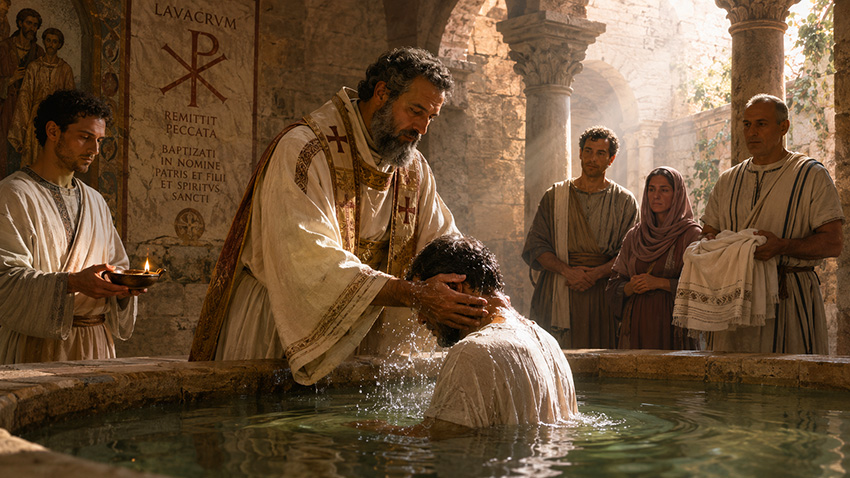
In the early church, baptism was not treated as a small religious formality or merely a public symbol. It was understood as part of the whole movement of conversion: turning from darkness to light, from Satan’s dominion to Christ’s kingdom, from the old life of sin to the new life of the Spirit.
When we speak about conversion in the early church, we must remember that the early Christians often saw it as a process of Christian initiation. This included repentance, instruction in the faith, renunciation of Satan, prayer, exorcism, baptism in water, laying on of hands, anointing, receiving the Holy Spirit, and entrance into the worshipping life of the church.
The exact details differed from place to place and from century to century, but the broad pattern is clear: baptism was seen as the decisive doorway into Christ and His church.
Biblical Foundation: From Darkness into Christ’s Kingdom
The early church did not invent the connection between baptism, deliverance, and salvation. They drew it from Scripture.
“He has delivered us from the power of darkness and conveyed us into the kingdom of the Son of His love.”
Colossians 1:13, NKJV
For the early Christians, conversion meant a transfer of lordship. A person was not simply adopting new religious ideas. They were being rescued from the dominion of darkness and brought under the reign of Christ.
This is also seen in Acts 2. When Peter preached at Pentecost, the people were “cut to the heart” and asked what they should do. Peter answered:
“Repent, and let every one of you be baptized in the name of Jesus Christ for the remission of sins; and you shall receive the gift of the Holy Spirit.”
Acts 2:38, NKJV
Faith, repentance, baptism, forgiveness of sins, and the gift of the Holy Spirit belonged together. The early church saw baptism as the normal and necessary act of initiation into the Christian life.
Acts 8 also shows the gospel arriving with power. As Philip preached in Samaria, unclean spirits came out of many, the sick were healed, and those who believed were baptized. Deliverance, healing, faith, and baptism were not treated as unrelated things, but as signs of the kingdom of God breaking into people’s lives.
Paul’s use of the Red Sea in 1 Corinthians 10 was also very important to early Christian writers. Israel was delivered from Pharaoh, passed through the sea, and entered into covenant life under God’s rule. The early church often saw Pharaoh as a picture of Satan, Egypt as bondage, and the Red Sea as a type of baptism. In the same way, Christians pass out of bondage and into Christ.
“Moreover, brethren, I do not want you to be unaware that all our fathers were under the cloud, all passed through the sea, all were baptized into Moses in the cloud and in the sea.”
1 Corinthians 10:1–2, NKJV
How Baptism Was Practised in the Early Church
In the earliest Christian centuries, baptism usually involved preparation. People were instructed in the faith, examined regarding their lifestyle, and expected to turn away from idolatry and sinful practices.
The Didache, an early Christian writing likely from the first or early second century, instructs believers to baptize “in the name of the Father, and of the Son, and of the Holy Spirit,” preferably in “living water,” meaning flowing water. If that was not available, other water could be used, and if immersion was not possible, water could be poured three times on the head. The Didache also mentions fasting before baptism and says that only the baptized should partake of the Eucharist.
Another early church document, commonly known as the Apostolic Tradition, describes a more developed baptismal preparation. Candidates were examined, instructed, prayed over, and exorcised before baptism. As baptism approached, the bishop laid hands on the candidates, commanded evil spirits to depart, breathed on them, and sealed them. Immediately before baptism, the candidate renounced Satan, was anointed with oil of exorcism, confessed the faith, and was then baptized. After baptism came further anointing, laying on of hands, and prayer for the Holy Spirit.
This shows that exorcism before baptism was not unusual in early Christian practice.
It did not always mean a dramatic deliverance scene as we might imagine today.
Often it was a formal prayer and command, declaring that the person no longer belonged to Satan but to Christ.
Tertullian: Baptism as Renunciation and New Allegiance
Tertullian lived in Carthage in North Africa, around the late second and early third century. He is one of the earliest major Latin Christian writers and helped shape the language of Western theology. His work On Baptism is the earliest surviving Christian treatise devoted specifically to baptism.
Tertullian wrote in a world filled with pagan temples, idols, magical rites, and mystery religions. For him, baptism was not merely a washing. It was a transfer of allegiance. The person coming to Christ had to break agreement with false gods, idolatry, and the devil.
In On Baptism, Tertullian notes that even pagan religions used water in their rites, but he saw this as a counterfeit of the true cleansing found in Christ. He argued that if pagan rituals recognized water as spiritually significant, how much more should Christians understand baptism as holy,powerful, and appointed by God.
Tertullian also describes the baptismal candidate renouncing the devil before entering the water. In De Corona, he says that Christians solemnly renounced the devil, his pomp, and his angels before baptism, and then underwent a threefold immersion.
For Tertullian, baptism included cleansing from sin, dedication to Christ, and preparation to receive the Holy Spirit. He also describes post-baptismal anointing and laying on of hands, through which the Holy Spirit was invoked upon the baptized believer.
In Tertullian’s view, baptism was a holy crossing-over: the believer publicly and spiritually renounced Satan and entered the lordship of Christ.
Cyprian: Baptism, Exorcism, and the Defeat of Satan
Cyprian was also from Carthage in North Africa. He was born around AD 200, became bishop of Carthage, and was martyred in AD 258. He led the church during times of persecution and wrote extensively about church unity, baptism, discipline, and martyrdom.
Cyprian strongly connected baptism with cleansing, church unity, and deliverance from the devil. In one of his letters, he uses the Red Sea image to describe baptism. Just as Pharaoh was defeated when Israel passed through the sea, so Satan’s power is broken when a person comes through the waters of baptism.
He writes that the devil may prevail up to the water, but in baptism he is beaten down, and the person dedicated to God is set free. Cyprian also refers to exorcists who rebuke and drive out evil spirits, but he sees baptism as the decisive moment where the person is sanctified and liberated.
This is very important. Cyprian did not treat exorcism and baptism as two unrelated ministries. Exorcism prepared the person, but baptism marked the final transfer from Satan’s claim to Christ’s ownership.
Cyprian’s church also dealt with questions about people coming from heretical or schismatic groups. At the Council of Carthage, bishops argued that such people should first be exorcised and then baptized into the true faith of the church. Some statements from that council explicitly mention that those coming into the church should be “first exorcised” and then baptized.
Cyprian also allowed for baptism by pouring or sprinkling in cases of sickness or necessity, showing that while the church valued the full baptismal rite, it also recognized pastoral exceptions.
Augustine: Baptism as Deliverance from the Power of Darkness
Augustine lived from AD 354 to 430 and became bishop of Hippo in North Africa. He is one of the most influential theologians in the history of the Western church. He was baptized by Ambrose in Milan in AD 387 and later wrote extensively on sin, grace, baptism, and salvation.
By Augustine’s time, Christianity had become more established in the Roman Empire, but baptism was still understood as deliverance from sin and the devil’s power. Augustine taught that baptism brings remission of sins and that through baptism a person dies to sin and is reborn. He applied this not only to adults but also to infants, connecting infant baptism with the forgiveness of original sin.
Augustine is especially important for the subject of exorcism before baptism. In On Marriage and Concupiscence, he says that even infants are redeemed from the power of the devil through baptism. He also refers to the devil being exorcised in infants and says that they renounce him through those who bring them to baptism, meaning their sponsors or parents.
This shows that baptismal exorcism was still part of the church’s practice in Augustine’s day.
Even where the person being baptized was an infant and could not personally speak,
the church still understood baptism as deliverance from the power of darkness and entrance into the kingdom of Christ.
What Did Exorcism Before Baptism Mean?
In the early church, baptismal exorcism did not always mean that every candidate was considered violently demon-possessed. Rather, it reflected a biblical worldview: outside of Christ, humanity is under sin, death, and the dominion of darkness.
Exorcism before baptism was a prayerful declaration that Satan’s claim was being rejected. The candidate renounced Satan, his works, his worship, and his ways. The minister prayed and commanded every evil power to depart. The person was then baptized into the name of the Father, Son, and Holy Spirit.
This means baptism was not viewed as a casual religious ceremony. It was a spiritual confrontation. The person was leaving one kingdom and entering another.
A Balanced Understanding for Today
The early church can help us recover a fuller understanding of baptism.
Baptism should not be reduced to an empty ritual, nor should it be treated as magic.
The water itself is not a charm. The power belongs to Christ.
But in the early Christian mind, baptism was the God-appointed place where faith, repentance,
cleansing, deliverance, and incorporation into the church came together.
Practical Lessons for the Church Today
- Baptism should be connected to repentance.
A person coming to Christ should be taught to turn away from sin, idolatry, occult practices, and every former allegiance that contradicts Jesus’ lordship. - Baptism should include a clear confession of faith.
The person being baptized should know who they are being baptized into: the Father, the Son, and the Holy Spirit. - The church should not be afraid to pray for deliverance where needed.
Some people come to Christ with deep bondage, occult involvement, addiction, fear, spiritual oppression, or destructive patterns. Prayer before baptism can be a powerful pastoral moment. - The renunciation of Satan is worth recovering.
A simple declaration such as, “I renounce Satan, all his works, and all his ways, and I give myself fully to Jesus Christ,” is deeply biblical and historically Christian. - Baptism should lead into discipleship and life in the body of Christ.
In the early church, baptism was not the end of the journey. It was the doorway into worship, communion, teaching, obedience, and fellowship.
Conclusion
For Tertullian, baptism meant renouncing the devil and being dedicated to Christ.
For Cyprian, baptism was the place where Satan was defeated like Pharaoh in the Red Sea.
For Augustine, baptism delivered even infants from the power of darkness and brought them under Christ’s grace.
The early church saw baptism as cleansing, deliverance, new birth, and initiation into the people of God.
It was not merely a symbol added onto conversion; it was part of conversion’s visible and spiritual completion.
To recover this vision today does not mean copying every ancient custom exactly.
It means recovering the seriousness, joy, and spiritual power of baptism.
When someone is baptized, they are not simply getting wet.
They are declaring that the old master has been renounced, sin no longer rules, Satan has no rightful claim, and Jesus Christ is Lord.
Historical References
- The Didache — Early Christian teaching on baptism
- Apostolic Tradition — Baptismal preparation, exorcism, renunciation, and anointing
- Tertullian, On Baptism
- Tertullian, De Corona
- Cyprian, Letter 75 — Baptism, exorcism, and the defeat of the devil
- Council of Carthage under Cyprian — References to exorcism and baptism
- Augustine, On the Merits and Forgiveness of Sins, and on the Baptism of Infants
- Augustine, On Marriage and Concupiscence — Baptismal exorcism and deliverance
- Encyclopaedia Britannica — Tertullian
- Encyclopaedia Britannica — Saint Cyprian
- Encyclopaedia Britannica — Saint Augustine