
4. How to Meditate on God’s Word: Filling Your Mind, Heart, and Mouth
Hover over or Tap the red scripture references to view content.
Many people want to know how to live a blessed, fruitful, stable, and spiritually successful life. Psalm 1 answers that question by describing two completely different paths. One path is shaped by the counsel of the ungodly, the behaviour of sinners, and the attitude of the scornful. The other path is shaped by delighting in God’s Word and meditating on it continually.
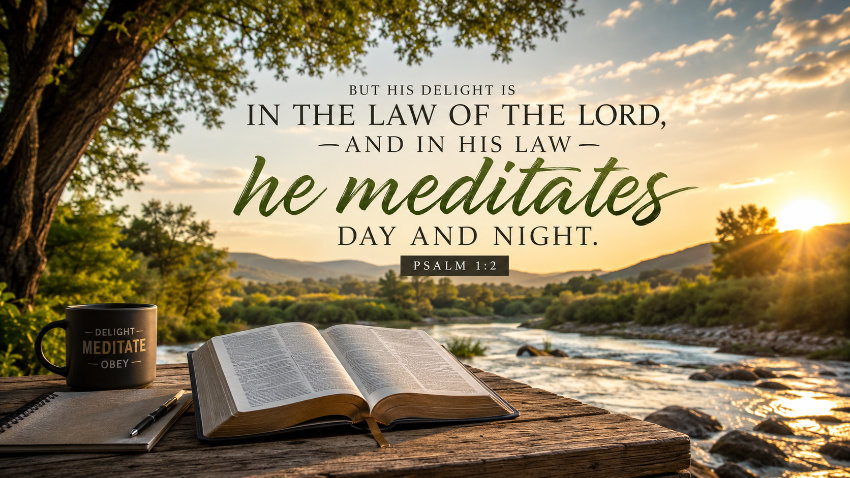
“But his delight is in the law of the LORD, And in His law he meditates day and night.”
Psalm 1:2 NKJV
Psalm 1:2 reveals one of the most important spiritual disciplines in Scripture: biblical meditation. It shows us how the Word of God moves from the pages of the Bible into our thoughts, words, decisions, attitudes, and daily lives. Biblical meditation is not merely reading a verse quickly and then forgetting it. It is taking the truth of God, holding it in our minds, speaking it with our mouths, receiving it into our hearts, and allowing it to direct our conduct.
The Blessed Person Chooses What Will Shape His Mind
Psalm 1 begins by describing what the blessed person refuses to do. He does not allow ungodly counsel to guide his thinking, sinful behaviour to determine his direction, or mockery to shape his attitude.
“Blessed is the man Who walks not in the counsel of the ungodly, Nor stands in the path of sinners, Nor sits in the seat of the scornful.”
Psalm 1:1 NKJV
Notice the progression: walking, standing, and sitting. A person first listens to ungodly counsel, then begins to follow an ungodly path, and eventually becomes settled in an ungodly position. What enters the mind can eventually determine where a person stands and how a person lives.
The blessed person therefore understands that he cannot meditate on everything he hears. He must choose carefully what he allows to remain in his thoughts. He refuses to let the opinions of the world become louder than the voice of God. Instead of continually rehearsing fear, anger, temptation, offence, disappointment, or unbelief, he turns his attention towards the truth of Scripture.
Psalm 1 does not merely tell us what to reject; it tells us what to embrace. The answer to ungodly counsel is not an empty mind. The answer is a mind filled with the instruction of the Lord.
“His Delight Is in the Law of the LORD”
The word translated as “law” refers to God’s instruction, teaching, direction, and revealed will. It includes more than rules and commandments. It describes the truth through which God teaches His people who He is, how He works, and how they should live.
The blessed person does not treat God’s Word as an unpleasant religious duty. His delight is in it. He treasures it because it reveals the heart of God, exposes deception, gives wisdom, corrects his direction, strengthens his faith, and shows him the way of life.
Delight changes meditation from a burden into a desire. We naturally think about what we value. A person in love thinks about the one he loves. A person concerned about money thinks about finances. A person consumed by fear repeatedly thinks about what might go wrong. In the same way, the person who delights in God’s Word continually returns to it because he recognises its value.
“Oh, how I love Your law! It is my meditation all the day.”
Psalm 119:97 NKJV
Biblical meditation therefore begins with more than discipline. It begins with recognising that God’s Word is good, trustworthy, powerful, and precious. The psalmist meditates because he delights, and the more he meditates, the deeper his delight becomes.
The Hebrew Meaning of “Meditate”
The Hebrew word translated as “meditates” in Psalm 1:2 comes from the verb הָגָה — hāgâ. In this verse, the form used is יֶהְגֶּה — yehgeh. The word can mean to ponder, muse, mutter, utter, speak quietly, or recite in a low voice.
This gives us a richer picture of biblical meditation. It certainly involves deep thought, but it is not limited to silent thought. The word can also describe making a low sound or quietly speaking something to oneself. Biblical meditation can therefore include reading Scripture slowly, repeating it, whispering it, speaking it aloud, praying it, and carefully considering what it means.
The image is not of a person allowing his mind to become inactive. It is the image of someone intensely occupied with truth. He turns the Word over in his thoughts, repeats it with his mouth, examines it from different directions, and asks how it applies to his life.
This connection between meditation and speaking becomes especially clear in God’s instruction to Joshua:
“This Book of the Law shall not depart from your mouth, but you shall meditate in it day and night, that you may observe to do according to all that is written in it.”
Joshua 1:8 NKJV
God connects Joshua’s mouth, meditation, and obedience. The Word was to remain in his mouth, occupy his thoughts, and govern his actions. Biblical meditation is therefore not merely thinking about Scripture. It is thinking, speaking, remembering, understanding, and obeying Scripture.
Biblical Meditation Is Not Emptying the Mind
Many practices commonly described as worldly, secular, or Eastern meditation emphasise detaching from thoughts, silencing the mind, focusing mainly on breathing, or attempting to reach a state of mental emptiness. Not every moment of silence or every breathing exercise is necessarily spiritual, and quietness itself is not wrong. Scripture often encourages us to become still before God. However, biblical meditation has a different foundation, object, and purpose.
The goal of biblical meditation is not to empty the mind of thought, but to fill the mind with God’s truth. It is not an attempt to disconnect from reality, but to see reality from God’s perspective. It is not focused on discovering truth within ourselves, but on receiving the truth that God has revealed in His Word.
Worldly meditation may ask a person to release every thought. Biblical meditation teaches us to examine our thoughts and bring them under the authority of God. Worldly meditation may seek peace through mental emptiness. Biblical meditation receives peace by filling the heart with the promises, character, presence, and faithfulness of God.
“And do not be conformed to this world, but be transformed by the renewing of your mind.”
Romans 12:2 NKJV
The mind is not renewed by remaining empty. It is renewed when old patterns of fear, lust, bitterness, pride, unbelief, and deception are replaced by the truth of God. Transformation takes place as Scripture changes what we believe, how we think, what we say, and how we respond.
The decisive question is therefore not merely, “Is my mind quiet?” The better question is, “What is filling and directing my mind?”
Biblical Meditation Fills the Mind with the Word
God created the mind to think, understand, remember, imagine, consider, and make decisions. Biblical meditation does not suspend these abilities. It brings them under the influence of Scripture.
“Your word I have hidden in my heart, That I might not sin against You.”
Psalm 119:11 NKJV
To hide the Word in the heart means more than memorising its wording. It means receiving it as truth, keeping it near, valuing it, and allowing it to become part of our inner life. When the Word is stored in the heart, the Holy Spirit can bring it to remembrance during temptation, uncertainty, suffering, decision-making, and spiritual warfare.
What we repeatedly think about becomes increasingly influential in our lives. When we repeatedly rehearse an offence, bitterness becomes stronger. When we repeatedly imagine disaster, fear grows. When we continually focus on temptation, sinful desire gains influence. But when we continually meditate on God’s character, commands, promises, and works, faith grows stronger.
Biblical meditation replaces the voice of fear with the promises of God, the voice of temptation with the holiness of God, the voice of condemnation with the finished work of Christ, and the voice of confusion with the wisdom of Scripture.
Biblical Meditation Includes Muttering and Speaking the Word
Because hāgâ can include muttering, uttering, or speaking quietly, biblical meditation may involve the mouth as well as the mind. This does not mean repeating words mechanically or treating Scripture like a magical formula. It means speaking the Word thoughtfully, reverently, believingly, and personally.
Suppose you are meditating on the words, “The LORD is my shepherd.” You could slowly speak the verse and emphasise each part:
“The LORD” — The Almighty God, Creator of heaven and earth, is the One caring for me.
“Is” — He is not merely the God who helped people in the past. He is my Shepherd now.
“My shepherd” — His care is personal. He leads me, protects me, provides for me, corrects me, and keeps me near Him.
As you speak and consider each phrase, the verse begins to move beyond general information. It becomes truth received by faith. This is meditation: slowing down long enough for the meaning of Scripture to enter deeply into the heart.
“Let the words of my mouth and the meditation of my heart Be acceptable in Your sight, O LORD, my strength and my Redeemer.”
Psalm 19:14 NKJV
The words of the mouth and the meditation of the heart are closely connected. What fills the heart eventually comes through the mouth, and what we repeatedly speak can reinforce what we are allowing into our hearts.
Meditation Must Lead to Obedience
Biblical meditation is not complete when we have merely understood a verse. Joshua 1:8 says that Joshua was to meditate so that he could “observe to do” everything God had commanded. The purpose of meditation is not simply information, inspiration, or emotional comfort. Its purpose is transformation and obedience.
We should therefore ask more than, “What does this verse mean?” We should also ask:
- What does this passage reveal about God?
- What does it reveal about my heart?
- Is there a command I must obey?
- Is there a promise I should believe?
- Is there a warning I should take seriously?
- Is there a sin I need to confess?
- Is there an attitude I need to change?
- How should this truth affect my words and actions today?
Meditation without obedience can produce knowledge without transformation. True biblical meditation prepares the heart to respond to God.
“But be doers of the word, and not hearers only, deceiving yourselves.” James 1:22 NKJV
What Does “Day and Night” Mean?
Psalm 1:2 says that the blessed person meditates on God’s law “day and night.” This does not mean that he does nothing except sit and recite Scripture every moment. It describes consistency. The Word of God remains part of his thinking throughout the different circumstances of life.
He returns to the Word in the morning before facing the day. He remembers it while working, travelling, making decisions, speaking with people, or facing temptation. He reflects on it again at night. Scripture becomes the steady reference point by which he interprets life.
To meditate day and night means that God’s Word is not restricted to church meetings or occasional Bible studies. It accompanies us into our homes, businesses, relationships, challenges, and private thoughts.
A Practical Way to Meditate on Scripture
Begin by choosing a short passage. Select one verse or a few connected verses rather than attempting to meditate on an entire chapter at once.
Read it slowly. Do not rush. Read the passage several times and notice repeated words, commands, promises, contrasts, and descriptions of God.
Speak it aloud. Read the verse quietly to yourself. Emphasise different words and allow their meaning to become clearer.
Think about its meaning. Ask what the passage meant in its context and what truth it communicates about God, humanity, faith, obedience, or salvation.
Personalise its application. Do not change the meaning of the verse, but ask how its truth applies to your present thoughts, attitudes, decisions, and circumstances.
Turn it into prayer. Thank God for the truth, confess where your life does not agree with it, and ask the Holy Spirit to help you obey it.
Repeat it throughout the day. Write it down, memorise it, speak it again, and return to it whenever your thoughts begin moving in the wrong direction.
Act on it. Decide what obedience looks like and put the Word into practice.
Meditation Produces Stability and Fruitfulness
Psalm 1:3 describes the result of delighting in and meditating on God’s Word:
“He shall be like a tree Planted by the rivers of water, That brings forth its fruit in its season, Whose leaf also shall not wither.”
Psalm 1:3 NKJV
A tree planted beside flowing water does not depend entirely on occasional rainfall. Its roots continually draw nourishment from a reliable source. In the same way, the believer who meditates on God’s Word is not sustained only by occasional spiritual experiences. His inner life is continually nourished by truth.
The storms may still come, but he has roots. The seasons may change, but his source remains. Difficulties may surround him, but they do not have to determine what is happening within him. Because his thoughts, faith, and decisions are being nourished by Scripture, he becomes spiritually stable and fruitful.
The fruit may not appear immediately. Psalm 1 says the tree produces fruit “in its season.” Meditation is not a quick religious technique for instant results. It is a way of becoming deeply rooted in God. Over time, the Word produces wisdom, endurance, holiness, peace, courage, self-control, discernment, and faithfulness.
What Are You Meditating On?
Everyone meditates on something. Worry is meditation focused on what might go wrong. Bitterness is meditation focused on what someone has done to us. Lust is meditation focused on sinful desire. Fear is meditation focused on danger without giving proper attention to the presence and power of God.
The question is not whether we meditate, but what receives our repeated attention. What thoughts do we rehearse? What conversations do we replay? What possibilities do we continually imagine? What voices are shaping our expectations?
Philippians teaches us to direct our thoughts intentionally:
“Whatever things are true, whatever things are noble, whatever things are just, whatever things are pure, whatever things are lovely… meditate on these things.”
Philippians 4:8 NKJV
Biblical meditation teaches us to interrupt destructive thought patterns and replace them with truth. Instead of allowing our minds to wander wherever fear, temptation, offence, or popular opinion leads them, we deliberately bring our attention back to what God has said.
Fill Your Mind Until the Word Fills Your Life
Biblical meditation is not about escaping life. It prepares us to live according to God’s will. It is not about emptying the mind, but filling it with truth. It is not merely silent reflection, but can include muttering, speaking, praying, remembering, and declaring the Word. It does not end with knowledge, but leads to obedience.
The blessed person of Psalm 1 has chosen his source. He will not be shaped by ungodly counsel because he is continually being shaped by God’s instruction. He delights in the Word, meditates on it, speaks it, believes it, and obeys it. As a result, he becomes like a well-rooted tree—stable in storms, nourished in dry seasons, and fruitful at the proper time.
Do not merely read the Word and close the Bible. Take the Word with you. Carry it in your thoughts. Speak it with your mouth. Pray it from your heart. Apply it to your circumstances. Obey it in your decisions. Return to it day and night.
The world may attempt to fill your mind with fear, confusion, temptation, and unbelief. Biblical meditation teaches you how to answer: fill your mind, heart, and mouth with the living Word of God until His truth becomes stronger in you than every other voice around you.