
 Hover over or Tap the red scripture references to view content.
Theme: “How?”
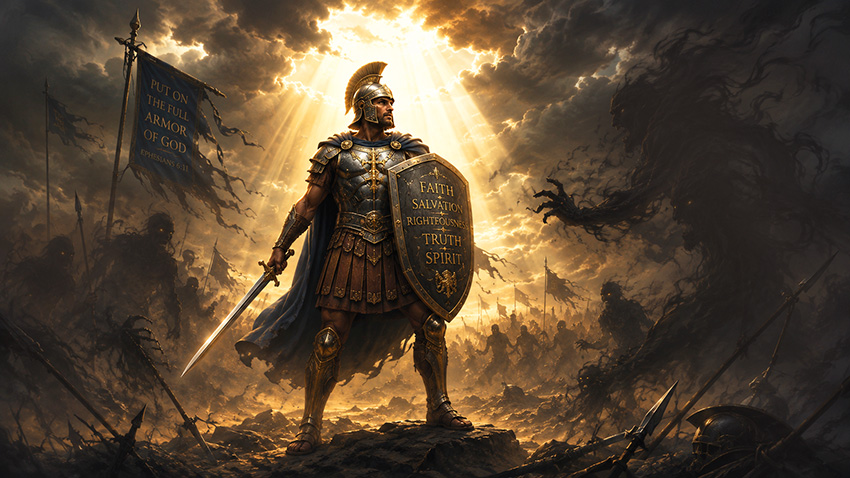
A clear and practical teaching on Ephesians 6:12–13, showing us how we as believers stand against spiritual opposition through God’s armour, discernment, faith, prayer, and obedience.
The important question is: How do we fight? Not every battle is fought with words, arguments, anger, human strength, or personal effort. According to Scripture, our real battle is spiritual, and therefore our victory must also come through spiritual means.
Paul writes:
“For we do not wrestle against flesh and blood, but against principalities, against powers, against the rulers of the darkness of this age, against spiritual hosts of wickedness in the heavenly places.”
Ephesians 6:12, NKJV
1. How Do We Understand the Battle?
Approximately 3,500 years ago, Moses came down from Mount Sinai and brought the Israelites the promise of a kingdom on this earth. But 2,000 years ago, Jesus came down from heaven and brought us the promise of a heavenly kingdom. This is the fundamental difference between the old covenant and the new.
If we do not understand this, we will not be able to wage effective warfare against Satan. Our kingdom is not of this world. Therefore, we must never fight or quarrel with human beings as though they are the real enemy.
This is one of the first requirements for effective spiritual warfare. One of the chief ways Satan tries to sidetrack believers from their calling is by getting them to fight or quarrel with others — with relatives, neighbours, brothers and sisters in Christ, or people around them. In many cases, the quarrel is over some earthly matter.
In this way, the enemy succeeds in dragging believers down from their heavenly position into earthly affairs, making them ineffective in their battle against him. If we want to fight Satan effectively and build the church, we must determine not to become involved in unnecessary disputes with people or over earthly things.
We must not even wage imaginary battles in our minds against others. We must guard our hearts from complaint, offence, bitterness, and resentment.
Paul begins by correcting our focus:
“For we do not wrestle against flesh and blood…”
Ephesians 6:12, NKJV
This does not mean people cannot hurt us, oppose us, or betray us. It means that people are not the ultimate enemy. Behind much of the conflict, confusion, accusation, division, and deception in this world, there is a spiritual battle taking place.
The enemy often wants us to fight the wrong target. If he can make us fight people, we become distracted and may miss what is happening in the spiritual realm.
In families, marriages, workplaces, churches, and homegroups, we must learn to ask:
- How is the enemy trying to work through this situation?
- How can I respond in the Spirit instead of reacting in the flesh?
- How can I stand without becoming bitter, angry, fearful, or discouraged?
2. How Do We Fight a Spiritual Battle?
We do not fight spiritual battles with fleshly weapons such as manipulation, revenge, gossip, shouting, pride, control, or anger.
Paul writes elsewhere:
“For the weapons of our warfare are not carnal but mighty in God for pulling down strongholds.”
2 Corinthians 10:4, NKJV
Our weapons are spiritual: truth, righteousness, faith, salvation, the Word of God, prayer, forgiveness, humility, obedience, and worship.
The Christian does not win by becoming harder, colder, emotionally withdrawn, or more aggressive. We win by becoming more submitted to Christ our Lord.
The question is not only, “What is attacking me?”
The deeper question is: “How do I stand in Christ while I am under pressure and under attack?”
3. How Do We Stand?
Paul gives us the answer in the next verse:
“Therefore take up the whole armor of God, that you may be able to withstand in the evil day, and having done all, to stand.”
Ephesians 6:13, NKJV
Paul repeats the word stand because the goal of the enemy is to move us.
- He wants to move us away from faith.
- He wants to move us away from truth.
- He wants to move us away from prayer.
- He wants to move us away from love.
- He wants to move us away from obedience.
- He wants to move us away from fellowship.
- He wants to move us away from our identity in Christ.
To stand means we refuse to surrender ground that Christ has already won. We stand because Jesus has already overcome.
“Yet in all these things we are more than conquerors through Him who loved us.”
Romans 8:37, NKJV
Standing is not passive, and it is not doing nothing. On the contrary, it is a strong spiritual position.
It means:
- I will not be moved away from Christ.
- I will not let fear or anxiety rule me.
- I will not let offence poison me.
- I will not let lies define me.
- I will not let temptation master me.
- I will not let darkness decide how I respond.
4. How Do We Take Up the Whole Armour of God?
Paul is specific when he says:
“Therefore take up the whole armor of God…”
Ephesians 6:13, NKJV
A believer cannot stand well if truth is missing. A believer cannot stand well if righteousness is ignored. A believer cannot stand well if faith is weak. A believer cannot stand well if the Word is neglected. A believer cannot stand well if prayer is absent.
God has not left us defenceless. He has provided everything we need to withstand the evil day.
The armour of God is the life of Christ applied practically to the believer. We take it up by deliberately choosing God’s way before the battle, during the battle, and after the battle.
5. How Do We Discern the Real Enemy?
Because our battle is not against flesh and blood, we need discernment.
Sometimes the enemy works through accusation and fear. Sometimes he works through temptation, offence, discouragement, confusion, false teaching, pride, or unforgiveness.
Peter warns us:
“Be sober, be vigilant; because your adversary the devil walks about like a roaring lion, seeking whom he may devour.”
1 Peter 5:8, NKJV
Notice the words sober and vigilant.
To be sober means we are spiritually awake. To be vigilant means we are watchful.
We should not become demon-focused, fearful, or suspicious of everything. That is not spiritual maturity. But we also should not be naïve. There is a real enemy, and he works best where believers are careless.
6. How Do We Respond in the Evil Day?
Paul says:
“…that you may be able to withstand in the evil day…”
Ephesians 6:13, NKJV
The evil day is the day of pressure or temptation. It is the day of accusation, fear, conflict, disappointment, or spiritual heaviness. It is the day when everything in us wants to give up, react, or compromise.
The evil day does not always announce itself. It may begin with a small offence, a fearful thought that we do not take captive, a harsh word given or received without an apology, a private temptation, or a discouraging report.
That is why we must be ready before the battle intensifies.
Jesus taught us to pray:
“And do not lead us into temptation, but deliver us from the evil one.”
Matthew 6:13, NKJV
We respond in the evil day by running to God, not away from Him.
- We pray.
- We confess the truth.
- We resist the devil.
- We submit to God.
- We forgive quickly.
- We refuse fear.
- We stay in fellowship.
- We hold on to the Word.
James gives us the order:
“Therefore submit to God. Resist the devil and he will flee from you.”
James 4:7, NKJV
First, submit to God. Then, resist the devil.
Many people try to resist the devil while still holding on to pride, sin, bitterness, or self-will. But true resistance begins with full surrender to God and dying to self.
7. How Do We Avoid Fighting People?
This is one of the most practical lessons in Ephesians 6.
When we forget that the battle is spiritual, we begin to see people as the enemy. Then our words become weapons, our hearts become hard, and our relationships become battlefields. We must avoid this at all cost.
But Jesus calls us to a different way:
“But I say to you, love your enemies, bless those who curse you, do good to those who hate you…”
Matthew 5:44, NKJV
This does not mean we allow verbal or physical abuse, tolerate evil practices, or ignore truth and sound doctrine. It means we refuse to become like the darkness we are resisting.
- We can set boundaries without hatred.
- We can speak truth without cruelty.
- We can correct without pride.
- We can walk away without bitterness.
- We can forgive without pretending nothing happened.
The enemy wants us to react in the flesh. God calls us to respond in the Spirit.
8. How Do We Keep Standing After the Battle?
Paul says:
“…and having done all, to stand.”
Ephesians 6:13, NKJV
There are times when we have prayed, obeyed, forgiven, resisted, waited, and trusted — and then we must simply keep standing.
Standing after the battle is sometimes harder than standing during the battle. After pressure, we may feel tired, disappointed, or emotionally drained. That is when we must not drop our guard.
Elijah experienced a great victory on Mount Carmel, but shortly afterwards he became fearful and discouraged. Spiritual victory does not mean we are immune to emotional weakness. We still need rest, fellowship, prayer, and encouragement.
That is why homegroup and church meetings are important. We do not stand alone.
“Bear one another’s burdens, and so fulfill the law of Christ.”
Galatians 6:2, NKJV
God often strengthens us through the Body of Christ.
9. Practical Ways to Apply This Teaching
Ask yourself honestly:
- Where am I fighting flesh and blood instead of recognising the spiritual battle?
- What area of my life is the enemy trying to move me from — faith, truth, love, purity, prayer, obedience, or fellowship?
- Am I trying to resist the devil while not fully submitting to God?
- What piece of the armour have I neglected?
- How can I stand this week in a practical way?
Practical Steps
Begin Each Day With Surrender
Pray:
“Lord, I submit my thoughts, words, emotions, and decisions to You today.”
Recognise Spiritual Pressure Early
Do not wait until fear, anger, offence, or temptation has taken over.
Refuse to Make People the Enemy
Deal with issues where needed, but guard your heart.
Speak the Truth of Scripture
The enemy works through lies, but truth is a weapon.
Stay Connected to Believers
Isolation makes battles harder. God often strengthens us through fellowship.
Pray Before Reacting
A delayed reaction can prevent a fleshly response.
Stand Your Ground in Christ
Do not surrender what Jesus has already won.
Conclusion: Stand in Christ
God is the One to whom we must give account. His Word is living and powerful, and He sees the thoughts and intents of every heart.
“For the word of God is living and powerful, and sharper than any two-edged sword, piercing even to the division of soul and spirit, and of joints and marrow, and is a discerner of the thoughts and intents of the heart.
And there is no creature hidden from His sight, but all things are naked and open to the eyes of Him to whom we must give account.”
Hebrews 4:12–13, NKJV
All our circumstances, including the way other people treat us, can be used by our loving Father for our good — to conform us to the likeness of His Son. Therefore, we have no room for complaint against people, but plenty of room for trusting God, obeying His Word, and praising Him at all times.
The battle is real, but so is the victory.
“The Lord will fight for you, and you shall hold your peace.”
Exodus 14:14, NKJV
So when the question is “How?”, the answer is:
- Stand in Christ.
- Stand in truth.
- Stand in faith.
- Stand in prayer.
- Stand together.
And having done all — stand.