
Water Baptism: What It Is and Why Every Believer Should Be Baptised
Hover over or Tap the red scripture references to view content.
Kliek hier vir die Afrikaanse weergawe.
Water baptism is one of the clearest and most beautiful acts of obedience in the Christian life. It is not a religious performance, and it is not “magic water”. Baptism does not save because water has power. Baptism matters because Jesus commanded it, the apostles practised it, and the New Testament presents it as the normal public response of a person who has repented and believed the gospel.
Peter gives us one of the clearest explanations of baptism:
“There is also an antitype which now saves us—baptism—not the removal of the filth of the flesh, but the answer of a good conscience toward God, through the resurrection of Jesus Christ.”
1 Peter 3:21, NKJV
Peter makes two things plain.
Firstly, baptism is not merely a physical washing. It is “not the removal of the filth of the flesh”. In other words, the water itself does not cleanse the heart.
Secondly, baptism is deeply spiritual. It is “the answer of a good conscience toward God”. It is a faith-filled response to God, made possible “through the resurrection of Jesus Christ”.
Baptism is therefore not an empty ritual. It is an outward act that expresses an inward reality. It is the believer’s public appeal to God, saying: “Lord Jesus, I trust You. I belong to You. My old life is buried, and I now live by Your resurrection power.”
1. Jesus Commanded Baptism
Baptism is not an optional extra for serious Christians. It is part of becoming a disciple of Jesus Christ.
Before Jesus ascended into heaven, He gave this command:
“Go therefore and make disciples of all the nations, baptising them in the name of the Father and of the Son and of the Holy Spirit, teaching them to observe all things that I have commanded you.”
Matthew 28:19–20, NKJV
Jesus did not say, “Make converts only.” He said, “Make disciples.” Baptism is part of that discipleship.
A person is not baptised to impress people, to join a denomination, or to complete a religious tradition. A person is baptised because Jesus is Lord, and His disciples obey Him.
“He who believes and is baptised will be saved; but he who does not believe will be condemned.”
Mark 16:16, NKJV
The emphasis is not that water saves without faith. The second part of the verse says condemnation comes through unbelief. But the first part shows the normal New Testament pattern: a person believes, and then that person is baptised.
Faith and baptism are not enemies. True faith gladly obeys Christ.
2. Baptism Is a Public Confession: “I Belong to Jesus”
In the New Testament, baptism was not hidden away as a private religious feeling. It was open, visible, and public.
On the Day of Pentecost, when the people were convicted by Peter’s preaching, they asked what they should do. Peter answered:
“Repent, and let every one of you be baptised in the name of Jesus Christ for the remission of sins; and you shall receive the gift of the Holy Spirit.”
Acts 2:38, NKJV
Then we read:
“Then those who gladly received his word were baptised; and that day about three thousand souls were added to them.”
Acts 2:41, NKJV
Notice the order: they received the word, and then they were baptised.
The same pattern is seen with the Ethiopian eunuch:
“Now as they went down the road, they came to some water. And the eunuch said, ‘See, here is water. What hinders me from being baptised?’”
Acts 8:36, NKJV
“Then Philip said, ‘If you believe with all your heart, you may.’ And he answered and said, ‘I believe that Jesus Christ is the Son of God.’”
Acts 8:37, NKJV
“So he commanded the chariot to stand still. And both Philip and the eunuch went down into the water, and he baptised him.”
Acts 8:38, NKJV
Baptism is a visible line in the sand. It says, “I am no longer ashamed of Christ. I have believed the gospel. I now belong to Jesus.”
3. Baptism Pictures Death, Burial, and Resurrection With Christ
Baptism is a God-given picture of the gospel.
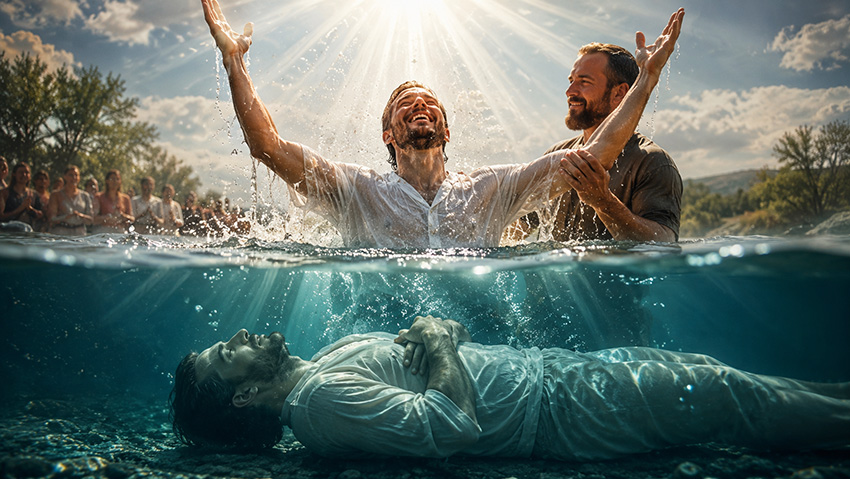
When a believer goes down into the water, it represents burial. When the believer comes up out of the water, it represents resurrection life.
Paul explains this clearly:
“Or do you not know that as many of us as were baptised into Christ Jesus were baptised into His death? Therefore we were buried with Him through baptism into death, that just as Christ was raised from the dead by the glory of the Father, even so we also should walk in newness of life.”
Romans 6:3–4, NKJV
Baptism preaches without a sermon.
Going down into the water declares: “My old life is finished.”
Coming up from the water declares: “I now live a new life in Christ.”
“Buried with Him in baptism, in which you also were raised with Him through faith in the working of God, who raised Him from the dead.”
Colossians 2:12, NKJV
This is why baptism is so powerful as a testimony. It is not merely a symbol of being washed. It is a declaration that the believer has been united with Christ in His death and resurrection.
4. Baptism Is Connected to Cleansing, but the Cleansing Comes Through Faith in Christ
The Bible connects baptism with cleansing, but we must understand this carefully. The water does not cleanse the soul by itself. The cleansing comes through faith in Jesus Christ, calling on His name, and the work of the Holy Spirit.
Ananias said to Saul:
“And now why are you waiting? Arise and be baptised, and wash away your sins, calling on the name of the Lord.”
Acts 22:16, NKJV
The key phrase is “calling on the name of the Lord”. Baptism is not presented as a mechanical ritual. It is connected to faith, repentance, and calling upon Christ.
“Not by works of righteousness which we have done, but according to His mercy He saved us, through the washing of regeneration and renewing of the Holy Spirit.”
Titus 3:5, NKJV
“Let us draw near with a true heart in full assurance of faith, having our hearts sprinkled from an evil conscience and our bodies washed with pure water.”
Hebrews 10:22, NKJV
The outward washing points to an inward cleansing. Baptism is the visible sign, but Christ is the Saviour. The water is not the power; the resurrection of Jesus Christ is the power.
That is why 1 Peter 3:21 is so important. Baptism is not merely washing dirt from the body. It is the answer of a good conscience toward God through the resurrection of Jesus Christ.
5. Baptism Marks a New Identity
Baptism is also a declaration of a new identity.
“For as many of you as were baptised into Christ have put on Christ.”
Galatians 3:27, NKJV
To be baptised into Christ is to declare that you no longer belong to the old life. You have “put on Christ”. Your identity is now found in Him.
Baptism says:
- I am not my past.
- I am not my sin.
- I am not my shame.
- I am not my old master.
- I belong to Jesus Christ.
It is also connected to the body of Christ:
“For by one Spirit we were all baptised into one body—whether Jews or Greeks, whether slaves or free—and have all been made to drink into one Spirit.”
1 Corinthians 12:13, NKJV
The Holy Spirit places believers into the body of Christ. Water baptism publicly confesses that spiritual reality.
Baptism does not make a person superior to others. It is an act of humility. It says, “I am now under the Lordship of Jesus Christ, and I am joined to His people.”
6. Baptism Strengthens the Believer’s Conscience
Peter says baptism is “the answer of a good conscience toward God”.
“There is also an antitype which now saves us—baptism—not the removal of the filth of the flesh, but the answer of a good conscience toward God, through the resurrection of Jesus Christ.”
1 Peter 3:21, NKJV
This is very important pastorally.
Many believers struggle with guilt, shame, and uncertainty. Baptism becomes a God-ordained milestone. It is a clear moment of obedience where the believer publicly says:
- Lord Jesus, I trust You.
- I renounce the old life.
- I belong to You.
- My conscience rests in Your finished work.
- My hope is in Your resurrection.
Baptism does not replace faith. It expresses faith.
Baptism does not replace repentance. It follows repentance.
Baptism does not save apart from Christ. It points directly to Christ.
7. The Biblical Pattern: Believe, Repent, Then Be Baptised
When we look at the New Testament, the normal pattern is clear: people hear the gospel, believe, repent, and are baptised.
“Then those who gladly received his word were baptised.”
Acts 2:41, NKJV
“But when they believed Philip as he preached the things concerning the kingdom of God and the name of Jesus Christ, both men and women were baptised.”
Acts 8:12, NKJV
“Then Philip said, ‘If you believe with all your heart, you may.’”
Acts 8:37, NKJV
“Can anyone forbid water, that these should not be baptised who have received the Holy Spirit just as we have?”
Acts 10:47, NKJV
“So they said, ‘Believe on the Lord Jesus Christ, and you will be saved, you and your household.’”
Acts 16:31, NKJV
“And immediately he and all his family were baptised.”
Acts 16:33, NKJV
The repeated pattern is faith first, then baptism.
That is why baptism should never be reduced to a cultural ceremony, family tradition, or religious naming service. Biblical baptism is the response of a person who has heard the gospel and personally responded to Christ.
8. What About Infant Baptism?
The New Testament gives clear examples of believers being baptised after receiving the word, repenting, and confessing faith. There is no direct command in the New Testament saying, “Baptise infants.” Those who defend infant baptism usually argue from covenant theology, household baptisms, church tradition, and the doctrine of original sin. Those who reject infant baptism argue that the New Testament pattern consistently connects baptism with personal faith and repentance.
Historically, infant baptism developed in the early centuries of the church and became increasingly tied to the doctrine of original sin. The Council of Carthage in AD 418 strongly connected infant baptism with the belief that infants needed baptism because of Adam’s sin.
The Roman Catholic Church still officially teaches that infants should be baptised shortly after birth, connecting infant baptism with freedom from original sin and becoming children of God. Therefore infant baptism became deeply embedded in Catholic sacramental tradition.
Many Reformers challenged Rome on major doctrines such as justification, indulgences, and papal authority, but they did not fully reform baptism back to the New Testament pattern of believer’s baptism. Luther and many other Reformers retained infant baptism, partly because they still understood baptism sacramentally and partly because church and society were deeply intertwined in Europe.
In many European societies, baptismal records were also used as official records of a person’s birth or identity before modern civil registration systems existed. Parish registers recorded baptisms, marriages, and burials, and in some places baptismal records functioned much like birth records before state birth registration became standard.
Therefore, it is fair to say that infant baptism became not only a religious practice, but also a social and civil marker in many state-church societies. In that environment, rejecting infant baptism was not merely a theological disagreement; it could also be seen as a rejection of the established social and religious order.
This helps explain why believer’s baptism was so controversial among groups such as the Anabaptists. They insisted that baptism should follow personal faith, not birth, nationality, or church tradition.
The key question is not, “What did tradition practise?” The key question is, “What does Scripture teach?”
And the New Testament pattern remains beautifully simple:
- Hear the gospel.
- Repent.
- Believe in Jesus Christ.
- Be baptised.
- Walk in newness of life.
9. Baptism Does Not Save by Works, but True Faith Obeys
We must keep the biblical balance.
We are saved by grace through faith, not by religious works.
“For by grace you have been saved through faith, and that not of yourselves; it is the gift of God, not of works, lest anyone should boast.”
Ephesians 2:8–9, NKJV
Baptism is not a work by which we earn salvation. No one can earn salvation by getting wet.
But true faith is obedient faith.
“If you love Me, keep My commandments.”
John 14:15, NKJV
So we should not speak of baptism as if it is unimportant. Jesus commanded it. The apostles preached it. The early believers practised it immediately. Baptism is the normal, obedient, public response of faith.
A person is not baptised to become worthy of salvation. A person is baptised because Christ is worthy of obedience.
10. A Simple Summary of Water Baptism
Water baptism is:
- A command of Jesus.
- A public confession of faith.
- A picture of death, burial, and resurrection with Christ.
- An outward sign of inward cleansing.
- A declaration of a new identity.
- An appeal to God from a good conscience.
- A step of obedience for every believer.
Baptism says:
- I have believed in Jesus Christ.
- My old life is buried.
- I now belong to Jesus.
- I rise to walk in newness of life.
11. Five-Minute Baptism Service Teaching
Before baptising someone, the following short teaching can be shared with the church or group.
Today we are witnessing something very important. Water baptism is not a religious performance and it is not magic water. The water itself does not save. Jesus Christ saves.
“There is also an antitype which now saves us—baptism—not the removal of the filth of the flesh, but the answer of a good conscience toward God, through the resurrection of Jesus Christ.”
1 Peter 3:21, NKJV
Baptism is the answer of a good conscience toward God. It is a public confession that this person has repented, believed in Jesus Christ, and now belongs to Him.
Jesus commanded His disciples to baptise:
“Go therefore and make disciples of all the nations, baptising them in the name of the Father and of the Son and of the Holy Spirit.”
Matthew 28:19, NKJV
Baptism also pictures the gospel.
“Therefore we were buried with Him through baptism into death, that just as Christ was raised from the dead by the glory of the Father, even so we also should walk in newness of life.”
Romans 6:4, NKJV
When this believer goes down into the water, it represents burial with Christ. When this believer comes up from the water, it represents being raised to a new life in Christ.
Today this person is declaring: “My old life is behind me. I belong to Jesus Christ. I now rise to walk in newness of life.”
12. Questions to Ask Before Baptism
These questions may be asked publicly before the baptism.
1. Do you believe that Jesus Christ is the Son of God, that He died for your sins, and that He rose again from the dead?
“That if you confess with your mouth the Lord Jesus and believe in your heart that God has raised Him from the dead, you will be saved.”
Romans 10:9, NKJV
2. Have you repented of your sins and turned to Jesus Christ as Lord?
“Repent therefore and be converted, that your sins may be blotted out.”
Acts 3:19, NKJV
3. Is it your desire to follow Jesus as His disciple and obey His Word?
“If you love Me, keep My commandments.”
John 14:15, NKJV
4. Do you renounce Satan, the works of darkness, and the old life of sin?
“To open their eyes, in order to turn them from darkness to light, and from the power of Satan to God.”
Acts 26:18, NKJV
5. Do you declare today that you belong to Jesus Christ alone?
“He has delivered us from the power of darkness and conveyed us into the kingdom of the Son of His love.”
Colossians 1:13, NKJV
Optional Question
6. Do you choose to forgive others and walk in love with the body of Christ?
“And be kind to one another, tenderhearted, forgiving one another, even as God in Christ forgave you.”
Ephesians 4:32, NKJV
13. Baptism Words
The minister may say:
“On your confession of faith in the Lord Jesus Christ, and in obedience to His command, I baptise you in the name of the Father, and of the Son, and of the Holy Spirit.”
Then immerse the person in water.
As the person comes up, the minister may say:
“Buried with Christ, raised to walk in newness of life.”
Based on Romans 6:4
Or:
“Raised with Him through faith in the working of God.”
Based on Colossians 2:12
Final Encouragement
If you have believed in Jesus Christ but have never been baptised as a believer, baptism is a beautiful and important step of obedience.
Do not delay because of fear, pride, uncertainty, or tradition. Baptism is not about proving that you are perfect. It is about confessing that Jesus Christ is your Lord.
You are not baptised because you have finished the race.
You are baptised because you have begun a new life.
“Therefore we were buried with Him through baptism into death, that just as Christ was raised from the dead by the glory of the Father, even so we also should walk in newness of life.”
Romans 6:4, NKJV